Metro Detroit Concierge Car Care: How & Why we think it Works
- Tyler Betthauser
- Jan 8
- 8 min read

Updated: Mar 20
Why your $50 oil change actually costs you $145
Auto repair has remained largely unchanged for decades. Customers purchase a vehicle, drive it, encounter maintenance needs, and return to a shop where they wait in a lobby. While vehicle technology has evolved, the service experience has not.
The Car Conservatory challenges this status quo. We believe the next evolution of auto care is not just about better tools, but a better operational model—one where the shop adapts to the customer’s schedule, not the other way around. By adopting a concierge first standard, we eliminate the lobby wait, reduce friction, and encourage timely maintenance.
This paper presents the operational logic and economic validation of the Concierge Car Care model. Through discrete-event simulation and algorithmic stress-testing, we demonstrate that traditional repair models impose a "Hidden Tax" of 20–50% on consumers via transit time, administrative friction, and lost productivity.
At A Glance: The Financial Case for Concierge Car Care
The Premise: Traditional auto repair imposes a "Hidden Tax" on consumers through lost time, administrative friction, and vehicle wear—costs that never appear on the invoice.
The Methodology: We utilized a proprietary discrete event simulation engine to stress-test The Car Conservatory’s concierge model against traditional shop workflows, quantifying the "Total Cost of Service" for the consumer.
The Results:
The "Drop-Off Tax": For a standard 2-hour repair, traditional logistics cost the customer an additional $130.60 in hidden transit and friction costs. The Concierge model reduces this to $0.00.
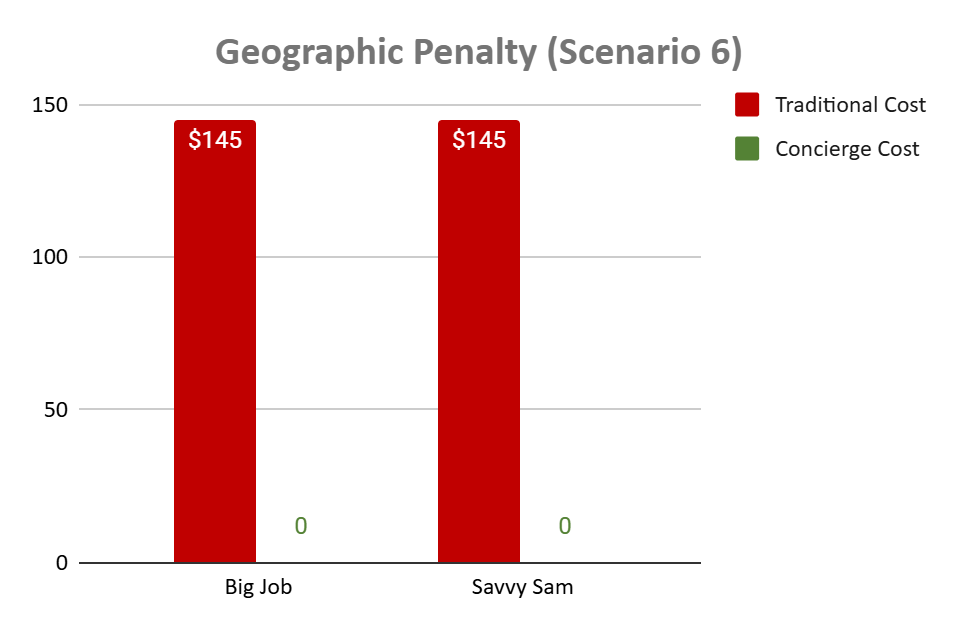
The Commuter Penalty: For clients traveling from adjacent affluent zip codes (e.g., Grosse Pointe to Macomb), the hidden cost of a single shop visit skyrockets to $145.07—nearly equal to our monthly subscription fee.
Universal Value: Our steel-man sensitivity analysis confirms that the Concierge model delivers positive ROI for any customer valuing their time above $18.50/hour, even when compared against competitors offering loaner vehicles.
The Bottom Line: By decoupling the vehicle owner from the logistics of repair, we lower the effective Total Cost of Service by 20–50% while maintaining market-standard pricing.
The Problem: A Stagnant Service Model
The automotive service industry suffers from a legacy operational paradigm: providers wait for customers, and customers must go to the providers. The introduction of appointments has failed to materially improve this experience. In reality, most appointments merely guarantee a spot in line, not an allocation of a technician's time. This miscommunication leads to a cycle of disappointment where vehicles sit untouched due to parts or labor unavailability.
This friction creates a secondary issue: Deferred Maintenance and Service. Because the typical shop experience is inconvenient, owners often delay necessary service. By removing the friction of the shop visit, The Car Conservatory encourages maintenance to be done on time, directly increasing vehicle reliability and longevity.
The Solution: An Innovative Concierge Model

Our model hinges on a simple premise: Your time is more valuable spent on your life than in our lobby.
While the mechanical repair itself is standard, the logistics of how it happens are where the revolution lies. We distinguish ourselves through bespoke coordination and frictionless service.
How Metro Detroit Concierge Car Care Works
Contact & Consult: You reach out via text, email, or online booking. We assess the need and prepare a plan.
Bespoke Coordination: We build a logistics plan—valet pick up, shuttle, or tow—handling the movement of the vehicle so you don't have to.
Frictionless Service: While our technicians perform expert repairs, you continue your day uninterrupted. There is no waiting room and no lost afternoon.
Updates & QA: You receive clear updates (including photos) via text, ensuring transparency without the need for phone tag.
Return Coordination: Once quality assurance is complete, we coordinate the return of your vehicle seamlessly.
Car Conservatory vs. the Traditional Shop
Legend: ✅ Standard | ⚠️ Inconsistent/Varies | ⛔ Not Offered

The Economics of Concierge Care
The financial model of our Metro Detroit Concierge Car Care postulates that regional input costs have reached a state of parity. Labor compensation for skilled technicians exhibits negligible variance across independent providers, and the commoditization of parts ensures material costs remain fixed.
Given this cost parity, legacy competitors often resort to volume-based sales tactics or overhead reduction to maintain margins—a race to the bottom that compromises service quality. The Car Conservatory rejects this strategy. Instead, we structure our model to deliver superior value retention at a competitive market rate.
The Value Algorithm
A critical output of this model is the quantification of the customer's Total Cost of Service (TCS). Traditional pricing models only account for the invoice amount. Our model integrates a Value Algorithm to calculate the hidden economic costs borne by the customer:
We sum three distinct cost vectors that your our service eliminates:

T: The actual time a customer in a specific zip code spends driving to a repair shop.
V: The localized hourly value of a customer's time. In our model, we use an hourly wage equivalent to the median household income for a given zip code.
D: The physical wear/tear and fuel saved by not driving the chase car. A Drop-off requires 2 round trips: 1. Target Car (To Shop) + Chase Car (To Shop + Back Home), 2. Target Car (Back Home) + Chase Car (To Shop + Back Home). This multiplier estimates the extra wear/labor of the second vehicle. We set it to 2.0 (Double the transit effort for drop-offs vs waiting).
C: The cost per mile to operate a vehicle (AAA standard).
T: The administrative time wasted (keys, payment, lobby). The Customer Service Index (CSI) Study often cites that satisfaction plummets if the service advisor handoff takes more than 12-15 minutes, yet the industry average often hovers higher during peak times.
M: The Psychological Multiplier—studies show unoccupied time (waiting) feels 1.2x to 1.5x longer than occupied time.
The Simulation: Proving the Model
To validate this logic, we developed a proprietary discrete event simulation engine using Python based stochastic modeling. This engine processed identical repair jobs through two logic systems:
Traditional Logic: first-come-first-serve scheduling with permissive capacity (overcrowding) and logistics.
Concierge Logic: efficiency weighted prioritization (profit/minute) with strict capacity gating and logistics.
Model Architecture
The simulation is governed by three primary constraint vectors:
Throughput Capacity (Service Bays): The finite limit of vehicles that can be actively serviced (N=2).
Storage Capacity (Parking Spots): The finite limit of vehicles that can be physically stored on-premises (N=5).
Time Constraints: Operating hours (8:00 AM – 5:00 PM) and hard customer deadlines ("Promise Times").
The model processes jobs through two distinct operational logics:
Traditional Logic: first-come-first-serve scheduling with permissive capacity (overcrowding) and logistics.
Concierge Logic: Efficiency prioritization (profit/minute) with strict capacity gating and logistics.
Simulation Scenarios
To ensure robustness, the model was stress tested against six specific operational conditions typical of an independent repair facility.
Scenario 1: The Morning Rush (Baseline)
Condition: Simultaneous arrival of mixed job types (brakes, oil, diagnostics) at 8:00 AM.
Objective: Measure the "Hidden Tax" imposed on customers during standard drop-off hours when they must physically drive to the facility.
Scenario 2: The Noon Crunch (Capacity Saturation)
Condition: Shop reaches maximum parking capacity (5/5 spots). A new, low-value job attempts to enter.
Objective: Compare handling of overcrowding. Traditional logic accepts the car, leading to lot congestion. Concierge logic triggers a "Reject/Reschedule" protocol, preserving shop flow.
Scenario 3: Efficiency Injection (The "Quick Turn" Opportunity)
Condition: A high margin, short duration job (e.g., battery replacement, $7.50/min gross profit) arrives at 1:00 PM behind a backlog of heavy repairs.
Objective: Demonstrate the financial impact of prioritization. Traditional logic buries the job in the queue (completion ~4:00 PM). Concierge logic elevates it (completion ~1:20 PM), capturing immediate revenue.
Scenario 4: Afternoon Release (Flow Recovery)
Condition: Completed vehicles depart, freeing up storage capacity.
Objective: Validate the system's ability to seamlessly ingest backlog items once operational constraints are lifted.
Scenario 5: The VIP Override (Subscriber Utility)
Condition: Artificial full lot state. A high value Subscriber and a non-subscriber both request service.
Objective: Test the VIP overflow protocol. The model verifies that subscribers can bypass capacity gates, guaranteeing access as a core value proposition of the membership.
Scenario 6: The Geographic Moat (The savvy customer)
Condition: A customer located 22 minutes away (e.g., Grosse Pointe to Macomb) requires minor service.
Objective: Quantify the geographic friction. This scenario calculates the exponential cost of distance when the customer is required to make multiple round trips (chase car logic).
Simulation Data:
Based on the simulation code we just built, here is the catalog of repair orders (Jobs) used to stress test the concierge model against the traditional model.
These jobs were specifically designed to represent a realistic "Day in the Life" mix of automotive work, ranging from quick low margin maintenance to complex high margin repairs.

The Chase Car Triggers (Jobs A01, C03)
Definition: Any job requiring >90 minutes of bay time.
Simulation Role: These jobs trigger the Chase Car Multiplier. In the Traditional Model, because the customer cannot wait 2+ hours in a lobby, they must arrange a ride home.
Economic Impact: This doubles the transit cost (2 round trips) and doubles the vehicle wear.
The "Lobby Waiters" (Jobs B02, D04, E05, F06)
Definition: Jobs taking <90 minutes.
Simulation Role: These represent the "I'll just wait for it" crowd.
Economic Impact: These jobs accrue friction costs (Admin time + Lobby wait time) but do not trigger the Chase Car penalty.
The Efficiency Disruptor (Job W99)
Definition: A battery replacement. High profit ($150), very low time (20 mins).
Simulation Role: This job appears at 1:00 PM to test the scheduler's logic.
Why it matters: It proves your model captures revenue faster than competitors.
The Geographic Edge Case (Job SAM)
Definition: A minor repair for a customer living 22.5 minutes away (45 min round trip).
Simulation Role: Tests the impact of distance.
Economic Impact: This job generates the massive $145.07 hidden cost figure. It proves that for distant customers, the "Transit Tax" of a traditional shop is often higher than the repair bill itself. This validates your "Geographic Moat" strategy for targeting affluent zip codes like Grosse Pointe.
Cost Breakdowns Visualized

Key Findings & Results
The simulation data empirically demonstrates that the Concierge model provides a quantifiable financial arbitrage for the consumer.
The "Drop-Off Tax"
For a standard 2-hour strut repair (Job C03), the Traditional model imposed $130.60 in hidden costs (transit wages, chase car logistics, and friction). The Concierge model reduced this hidden cost to $0.00.
The Commuter Penalty
For a customer commuting from Grosse Pointe (Scenario 6), the hidden cost of a single visit was $145.07—nearly equal to the proposed monthly subscription fee. This validates the "Geographic Moat" strategy: for distant customers, the "Transit Tax" of a traditional shop often exceeds the repair bill itself.
Aggregate Impact
In a single modeled morning shift, the Concierge model returned $558.88 of economic value to the customer base simply by eliminating non-value-added logistics.
Robustness Checks & Sensitivity Analysis
To ensure our findings were not reliant on optimistic assumptions, we subjected the model to a stress test. We compared our efficiency not against an average shop, but against a "Best-in-Class" competitor offering loaner vehicles and efficient processing.
The Verdict: Even under conservative constraints (using marginal vehicle costs of $0.30/mile), the Concierge Model generates a positive consumer surplus for any customer valuing their time above $18.50/hour.
For our target demographic (Household Income >$150k, Wage ~$75/hr), the model recovers $95.00 – $140.00 of economic value per service event, irrespective of the invoice cost.
Key Stress Test Findings
Sensitivities at various Hourly Wages
Our model found that at various wages common in the area, these customers can still see savings and find value in our services.

Savings as Compared to An Average Shop versus Our Best Competitor
When we compared our offerings to an average or best-in-class competitor (a business that might offer similar concierge offerings but not standard), the model seems to indicate that customers still see savings .

Cost Impacts According to Geographic Area
The model assesses costs for those customers who travel significant distances to shops. One of the customers we interviewed noted that she has a Mazda and the closest preferred dealer is 40+ minutes away. She incurs significant, seemingly intangible, costs as compared to our model.
Conclusion
The data is clear. By decoupling the vehicle owner from the logistics of repair, The Car Conservatory does not just offer convenience; we offer a measurable return on investment. We effectively lower the Total Cost of Service by 20–50% compared to traditional competitors, while maintaining market-standard invoice pricing


Comments