The Contact Patch: A Guide to Modern Suspension Systems & Diagnostics.
- Tyler Betthauser
- Feb 22
- 33 min read

Updated: Mar 19
Introduction
Automotive service centers frequently receive inquiries regarding mysterious noises, vibrations, or unusual sensations encountered over road imperfections. These symptoms can be deeply unsettling for drivers and often signal underlying suspension issues that require professional attention. To understand these complexities, one must first examine the fundamental mechanics and design philosophies of modern suspension systems. This article provides a comprehensive overview of suspension geometries, construction materials, and the critical components that maintain vehicle stability (including some of the more advanced electrical components). We will also explore the vital relationship between suspension health and wheel alignment, as well as how tire wear patterns serve as a diagnostic map for internal failures. Because the suspension is a primary pillar of the safety triangle, alongside brakes and tires. we also examine common failure modes encountered throughout a vehicle’s lifecycle. Finally, we elaborate on the diagnostic process employed at The Car Conservatory to ensure your vehicle returns to its optimal state of safety and performance..
Reference
This document is not necessarily meant to be read from top to bottom--unless of course you are interested in these systems and want a pretty high-level view of the technical but a deeper dive into the diagnostic process. Here are some quick links to information that might be most applicable to your vehicle and interests. Also, there are entire volumes of books that go into far greater detail than this document. This is meant for the interested car owner and maybe a technician who happens to stumble on the article.
Architecture | Representative Makes & Models | Model Eras | Engineering & Diagnostic Concepts | Diagnostic Protocols |
|---|---|---|---|---|
MacPherson Strut | Ford Mustang, Porsche 911 (Front), Most BMW/Audi Sedans | 1950s–Present | Space efficiency, single pivot units, steering torque, top mount bearings | Loaded-bearing rotation test, bounce recovery test |
Double Wishbone | Mercedes-Benz S-Class (Front), Audi A8, Honda NSX, Performance SUVs | 1940s–Present | Camber gain, contact patch optimization, A-arm synchronization | Camber-sweep gauge test, upper wishbone bushing check |
Multi-Link | BMW 3/5 Series (Rear), Mercedes E-Class (Rear), Audi A4/A6 | 1980s–Present | Elasto-kinematics, lateral stiffness, five-link precision | Lateral deflection test, highway stability road test |
Solid / Live Axle | Ford F-150, Jeep Wrangler, Mercedes G-Wagon, RAM 1500 | 1930s–Present | Load bearing, off-road articulation, track bar bushings | Dry-park steering test, frame-to-axle measurement |
Active / Mechatronic | Cadillac (MagneRide), Corvette, Ferrari, BMW (EDC) | 2002–Present | Magnetorheological fluid, adaptive valving, CAN-bus networking | Damper solenoid actuation test, sensor-drift interrogation |
Pneumatic / Air Ride | Mercedes GL/GLS, Tesla Model S/X, Land Rover Range Rover | 1990s–Present | Pressurized bellows, constant ride height, compressors | Soapy water spray test, overnight leak-down log |
Universal Geometry | All Modern Passenger Vehicles | All Eras | Unsprung weight, Safety Triangle, bushing memory effect | Precision 3D alignment, "while-you-re-in-there" strategy |
Fundamentals: What is a Suspension?
At its most basic level, an automotive suspension is the collection of springs, shock absorbers, and linkages that connects a vehicle to its wheels. It serves as the primary interface between the chassis—where the passengers sit—and the road surface. While it might seem like a passive system, the suspension is a dynamic mechanical computer that constantly calculates how to manage energy, weight, and friction in real-time.
The Dual Mandate: Passenger Comfort vs. Mechanical Grip
The engineering of a suspension system is a perpetual balancing act between two conflicting goals:
Passenger Comfort (Isolation): To provide a smooth ride, the suspension must isolate the cabin from the vertical accelerations caused by potholes, expansion joints, and uneven pavement. This requires a certain degree of softness or compliance to soak up energy before it reaches the seats. Although, enthusiasts and race car drivers actually prefer the communication between the suspension and road. Most drivers are not exactly
Mechanical Tire Contact (Road Holding): For safety and performance, the suspension must keep the tire’s contact patch—the small area of rubber actually touching the pavement—firmly pressed against the road. If a tire bounces off the ground, you lose the ability to steer, brake, or accelerate. This requires stiffness to control the mass of the wheel and tire.
Managing the Body: Pitch, Squat, and Roll
Beyond just absorbing bumps, the suspension manages the feel of the vehicle body during driving maneuvers. A well tuned system controls three primary types of movement:
Pitch: The forward leaning of the car during heavy braking (nose-dive).
Squat: The rearward leaning of the car during hard acceleration.
Roll: The leaning of the car toward the outside of a turn.
By controlling these forces, the suspension ensures that the vehicle remains level and predictable, which prevents the weight from shifting too violently and upsetting the balance of the tires.
The Safety Triangle
In the automotive industry, we often refer to the Safety Triangle: Brakes, Tires, and Suspension. These three systems are inextricably linked. You can have the best brakes in the world, but if your worn out shocks allow the tires to hop and skip across the pavement, the ABS system cannot effectively stop the car. Likewise, even the most expensive performance tires will wear out in a matter of months if a bent suspension component ruins the alignment geometry.


A failure in any one leg of this triangle compromises the other two. This is why we treat suspension health not just as a matter of comfort, but as a critical safety requirement for every vehicle that leaves the shop. And while modifying a vehicles' suspension can be fun and more aesthetically appealing, there are significant safety concerns when done improperly and often cause premature wear elsewhere. Even modification of the engine and brakes can have their own impacts on the suspension itself.
The evolution of the automotive suspension is a history of managing energy. Early designers focused on simply preventing the vehicle from shaking itself apart; modern engineers focus on optimizing the tire's contact patch through complex mathematics and materials science.
The Era of Compliance: Carriage Springs and Solid Axles
The earliest automotive suspensions were direct carry overs from horse-drawn carriages. This era was defined by the leaf spring—a series of stacked metal plates that bowed under load. While durable, leaf springs were heavy and suffered from high internal friction, making them poor at absorbing small, high frequency bumps. And yet, the vestiges of these early technologies are still used today! There are models still using leaf springs (albeit modified heavily from the early versions) in modern pickup trucks.

Until the 1930s, most vehicles used solid axles, where the front wheels were physically connected by a single beam. This meant that any disturbance on the left wheel was immediately transmitted to the right wheel, often leading to a phenomenon known as death wobble or shimmy at high speeds (Bastow et al., 2004). While solid axles tend to be in luxury off-roading vehicles in the modern context, coveted by enthusiast, the consumer grade solution is a simple steel beam with a spring.

The Mid-Century Shift: Independent Front Suspension (IFS)
The transition to Independent Front Suspension (IFS) in the 1930s and 40s was the first major leap in engineering. Led by companies like Cadillac and Packard, and popularized in Europe by Mercedes-Benz, IFS allowed each wheel to react to the road independently.

The introduction of the MacPherson Strut in the late 1940s—patented by Earle S. MacPherson at Ford—revolutionized the industry by combining the shock absorber and the upper steering pivot into a single unit (Heisler, 2002). This design saved immense space in the engine bay, allowing for the compact front-wheel-drive layouts that dominate the market today.

The Rise of Precision: The European Influence
As speeds increased on the German Autobahn and the American Interstate system, the limitations of simple suspensions became dangerous. European manufacturers, specifically BMW and Mercedes-Benz, began refining the Multi-Link rear suspension in the 1980s.
Instead of a single control arm, the multi-link system uses five or more individual links to locate the wheel. This allows engineers to separate vertical ride comfort from lateral cornering stiffness—a concept known as elasto-kinematics (Reimpell et al., 2001). This period marked the shift from brute force suspension to precision geometry, where every movement of the wheel is calculated to maintain the ideal camber angle.

The Digital Revolution: Active and Adaptive Systems
The current era of suspension engineering is defined by the move from passive components to mechatronics. Traditionally, a shock absorber was a dumb device—its stiffness was fixed by its internal valves.
The 1990s and 2000s saw the introduction of Adaptive Damping, where electronic solenoids could change the oil flow inside a shock in milliseconds. This culminated in technologies like Magnetic Ride Control (MR), which uses electromagnetic coils to change the viscosity of the fluid itself, and Air Suspension (AS), which replaces steel springs with pressurized rubber bellows. Today, the suspension is no longer a separate mechanical system; it is a networked component that talks to the vehicle's GPS, cameras, and stability control systems to predict the road ahead rather than just reacting to it (Gillespie, 1992).

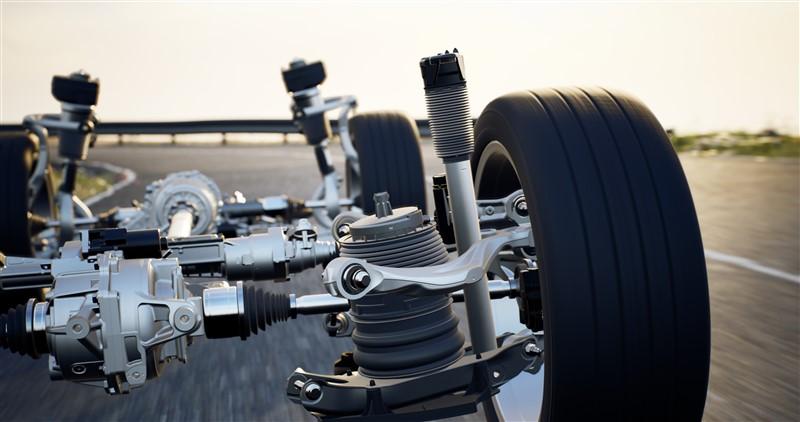


Translating the Feel: The Subjective Experience
When a vehicle enters the shop with a suspension concern, the diagnostic process begins with a translation of sensory data. Drivers often struggle to articulate specific mechanical failures, but they are highly attuned to changes in how the vehicle handles road imperfections. We categorize these experiences into three primary channels: sound, touch, and sight.
Aural Diagnostics
Suspension noises are rarely random. A heavy metallic clunk over speed bumps typically points to exhausted bushings or failing ball joints that have developed excessive play. High pitched squeaks often indicate rubber components that have dried out or became contaminated with road salt, causing friction against metal mounting points. A rhythmic rattle on relatively smooth pavement might suggest a loose sway bar link or a top strut mount that has lost its structural integrity.
Differentiating between front-end and rear-end suspension noise is a fundamental skill in automotive diagnostics because the human ear can be easily deceived by the acoustic properties of a vehicle cabin. A noise that sounds like it is emanating from the dashboard may actually be traveling through the unibody from a rear control arm.
Directional Sound Mapping
The primary challenge in aural diagnostics is that modern cars are designed to be well-insulated, which often turns the cabin into a resonator. To isolate the source, we pay close attention to when the sound occurs relative to the vehicle's movement.
Front end noises are almost always tied to steering input or primary impact. If a clunk occurs specifically when turning the wheels while stationary or at low speeds, the culprit is likely a front strut mount or a binding ball joint. Because the front suspension handles the majority of the braking force and steering geometry changes, these components are under higher dynamic stress.
Rear end noises are typically more localized to vertical travel. A thumping sound from the rear that persists on a straight but bumpy road, yet remains silent during steering maneuvers, points toward rear shock mounts or trailing arm bushings. In European multi-link setups, a faint clicking during initial acceleration or braking often indicates play in the rear lateral links as they struggle to maintain the wheel's longitudinal position.
The Role of Resonance and Load
Aural diagnostics also involve manipulating the load on the suspension to see how the sound changes. We use the following techniques to distinguish between the two ends of the car:
Weight Transfer: By applying the brakes firmly, we shift the vehicle's weight to the front. If a noise disappears under braking but returns during coasting, it suggests the front components are being loaded into a position where the play is temporarily eliminated, or conversely, that the rear is being unloaded, allowing a loose component to rattle.
Acoustic Pathways: Sound travels efficiently through metal. A failing front wheel bearing often creates a hum that sounds like it is coming from the center of the car. However, by slightly swerving the car left and right (loading the bearings), we can identify which side, and which end, is failing based on the change in pitch.
The Chassis Ears Method: For particularly stubborn noises that seem to move around the cabin, we utilize electronic chassis ears. These are microphone clamps attached to specific components like the subframe, strut towers, or rear control arms. This allows us to listen to each component in real time while the vehicle is in motion, removing the guesswork inherent in subjective cabin listening.
Tactile Feedback
The location of a vibration provides a significant clue regarding the source of the fault. Shaking felt primarily through the steering wheel often originates in the front end, involving components like tie rod ends, control arm bushings, or front wheel balance. Conversely, vibrations felt through the seat or floorboard usually suggest issues in the rear suspension or the drivetrain. If a vehicle feels floaty or continues to bounce after a dip in the road, the dampers have likely lost their ability to control the kinetic energy of the springs.
Visual Cues
Tire wear serves as a permanent record of suspension geometry. Feathering, where the tread blocks develop sharp edges on one side, is a classic sign of improper toe settings. Cupping, which appears as scalloped dips around the circumference of the tire, indicates that the wheel is literally bouncing down the road due to worn shocks or struts. One sided wear, either on the inner or outer shoulder, usually signals a camber issue often caused by bent components or sagging springs.
While the tire's tread acts as a historical record of suspension health, a physical inspection underneath the vehicle provides immediate evidence of component degradation. Visual diagnostics in a shop environment often reveal failures long before they result in a catastrophic mechanical break.
The Integrity of Rubber and Seals
The most common visual indicator of an aging suspension is the condition of rubber boots and bushings.
Bushing Tears: Control arm bushings are designed to allow for controlled movement. When they fail, the rubber begins to crack or dry rot, eventually tearing away from the metal sleeve. You can often see the rubber pulling away or appearing off center within the arm, which indicates the arm is no longer being held in its proper geometric position.
Split Boots: Ball joints, tie rod ends, and CV joints are encased in rubber or plastic boots to keep grease in and contaminants out. A visible tear or weeping grease around these joints is a definitive sign of upcoming failure. Once the boot is compromised, road salt and grit enter the joint, acting like sandpaper and rapidly grinding down the precision-machined surfaces.
Hydraulic Leaks and Sweating
Dampers are filled with hydraulic oil. While a very slight film of oil (often called sweating) can be normal on some higher mileage shocks, a wet looking appearance is a failure.
Active Leaking: If the body of the shock or strut is covered in wet, dark oil, the internal seals have failed. This means the unit can no longer provide the necessary resistance to control the spring's movement.
The Dust Trap: Often, you will see a thick buildup of road grime and dirt caked onto the side of a strut. This happens because the leaking oil acts as an adhesive for Michigan road dust. This buildup is a primary visual cue that the damper is no longer functional.
Advanced Systems: Magnetic and Air Ride
The diagnostic cues for electronic and pneumatic systems differ significantly from traditional coil over setups.
Magnetic Ride Control (Magnetorheological Dampers)
Magnetic ride dampers do not have traditional valves, but they still rely on fluid. A visual failure here often looks like a crust forming around the top of the damper. Because the fluid contains iron particles, a leak can appear darker or more metallic than standard hydraulic fluid. Additionally, we inspect the electrical connectors at the top or bottom of the strut; if these wires are frayed or the plastic housing is cracked from road debris, the system will default to its stiffest setting, resulting in a harsh, unforgiving ride.
Air Suspension Systems
Air ride failures are often visible before you even put the car on a lift.
The Hunker: If a vehicle is sitting noticeably lower on one corner after being parked overnight, there is a leak in that corner's air bag or the connecting line.
Air Bag Cracking: Upon closer inspection of the air spring, the thick rubber bladder, we look for checking or small cracks at the base where the bag folds over itself. These cracks are early warning signs that the rubber is reaching the end of its fatigue life.
Corroded Fittings: In the Midwest, the brass or plastic fittings where the air lines meet the struts often succumb to salt-induced corrosion. We look for white, powdery oxidation or bubbling (using a soapy water solution) to identify exactly where the pressure is escaping.
The Architecture: Main Types of Suspension Geometries
The design of a suspension system—its geometry—determines how a wheel moves relative to the chassis as it travels up and down. This movement is not just vertical; as the suspension compresses, the wheel’s angle relative to the road (camber) and its direction relative to the vehicle's centerline (toe) change. Mastering these geometries is what separates a predictable, high-performance vehicle from one that feels unstable under stress.
MacPherson Strut: Simplicity and Space Efficiency
The MacPherson strut is a structural suspension system where the damper unit serves as the primary vertical load carrier and the upper locating link. It is defined by its minimalist component count, typically consisting of a single lower control arm (or wishbone), a coil-over-strut assembly, and a steering knuckle. The strut assembly combines the shock absorber and the coil spring into one unit, which is bolted to the chassis at the top through a strut mount containing a bearing. This bearing allows the entire strut to rotate, meaning the strut itself acts as the kingpin or steering axis. Because the strut replaces the upper control arm, the system requires fewer bushings and ball joints, reducing both manufacturing costs and mechanical complexity.
When the vehicle encounters a bump, the lower control arm pivots upward, and the strut assembly compresses along its axis. Because the top of the strut is fixed to the inner wing of the chassis, the arc traced by the lower control arm dictates the movement of the wheel. During a turn, the driver rotates the steering wheel, which turns the entire strut and knuckle assembly around the upper mount and the lower ball joint. This dual-purpose role, handling both damping and steering orientation, is what makes the design so space-efficient, allowing for larger engine bays or better packaging in front-wheel-drive layouts.
From a geometric perspective, the MacPherson strut faces challenges with camber gain. As the suspension compresses (jounce), the wheel typically moves through an arc that causes the top of the tire to lean outward relative to the chassis, known as positive camber change. In a hard corner, where the body rolls and the outside suspension compresses, this prevents the tire from staying flat against the road surface. According to Advanced Vehicle Technology (Heisler, 2002), this lack of camber compensation reduces the contact patch of the tire under high lateral loads, leading to less predictable grip at the limit compared to multi-link setups.
The driver experience in a vehicle with MacPherson struts is generally characterized by a high degree of road feel or kickback through the steering wheel. Because the strut is a structural member, road shocks are transmitted more directly to the steering rack and the drivers hands. During aggressive cornering, the driver may feel a progressive loss of front-end bite as the tire leans away from the turn, often resulting in understeer. While the setup is excellent for predictable, daily transit, a driver on a track might find it lacks the planted sensation of more complex geometries that can keep the tire perpendicular to the pavement throughout the entire range of motion.
Double Wishbone: Superior Geometry Control
The double wishbone suspension, or unequal-length A-arm system, is defined by two parallel or near-parallel lateral links, the upper and lower control arms, which connect the steering knuckle to the chassis. These arms are typically A-shaped or V-shaped, providing longitudinal and lateral rigidity. The spring and damper unit usually attaches to the lower control arm and passes through or around the upper arm to mount to the vehicle frame. Unlike the MacPherson strut, the damper in this architecture is not a structural load-bearing member for steering; its sole job is to manage vertical energy and control oscillation.
When the vehicle hits a bump, both control arms pivot upward. Because these arms can be designed with different lengths and mounting angles, engineers can dictate exactly how the wheel tilts as it moves. In a turn, as the body of the vehicle rolls, the outside suspension compresses. The geometry is typically set up so that the upper arm is shorter than the lower arm. This configuration causes the top of the steering knuckle to be pulled inward more aggressively than the bottom during compression, creating negative camber. This counteracts the natural tendency of the tire to lean outward as the car rolls, ensuring the tire tread remains flat and maintains a maximum contact patch with the road (Bastow et al., 2004).
For the driver, this architecture provides a more sophisticated and stable steering feel. Because the steering axis is decoupled from the damping forces, the steering wheel is less prone to interference from road irregularities. The driver will experience higher lateral grip and more consistent feedback during high-speed cornering. There is a more grounded sensation where the front end feels more glued to the pavement, especially during mid-corner bumps where a MacPherson strut might cause the car to skip or lose its line. The trade-off for the driver is often a heavier steering weight and a vehicle that feels wider due to the packaging requirements of the long control arms.
Multi-Link: The Complexity of Modern European Design
A multi-link suspension is defined by the use of three or more independent lateral and longitudinal arms to locate the wheel hub. Unlike the fixed geometry of a wishbone, these individual links—often referred to as control arms, tie links, or trailing links—attach to the chassis and the wheel carrier at specific points to manage five of the six degrees of freedom of the wheel. This allows the sixth degree, vertical travel, to be controlled by the spring and damper assembly. By separating these forces, engineers can manipulate the wheels orientation with extreme precision throughout its entire range of motion (Reimpell et al., 2001).
When a vehicle with a multi-link rear suspension hits a bump, the individual links work in concert to ensure the wheel moves vertically while maintaining an ideal contact patch. In a turn, the lateral links manage the lateral loading forces to keep the tire at the optimal camber angle. A unique feature of this architecture is its response to braking and acceleration. Under heavy braking, the geometry is often designed to induce a slight toe-in (where the front of the tires point toward each other). This passive steering effect stabilizes the rear end, preventing the car from fishtailing or wandering under high deceleration.
The concept of elasto-kinematics is central to the multi-link design. It involves tuning the stiffness of the rubber or polyurethane bushings at the end of each link. When a force is applied, such as during a hard corner or a sudden brake application, the bushings compress by calculated amounts. This allows the wheel to steer itself slightly to counteract the forces acting on the chassis.
For the driver, this translates to a sensation of immense stability and a planted rear end. The car feels more composed over mid corner bumps because the links can absorb longitudinal shocks without compromising lateral grip. However, because there are so many pivot points and bushings, the driver may experience a slightly more isolated or filtered steering feel compared to the raw feedback of a double wishbone setup.
Solid Axle vs. Independent: The Stability Trade-Off
The solid axle, often referred to as a live axle when it transmits power, is defined by a single rigid beam that connects the left and right wheel hubs. In this architecture, the differential, axle shafts, and wheel bearings are typically housed within one continuous metal casing. This assembly is usually suspended by leaf springs or a combination of coil springs and locating links like a Panhard rod or a Watts link. The primary characteristic of a solid axle is that the wheels are kinematically linked; any change in the position or angle of one wheel dictates a corresponding change in the other.
When a vehicle with a solid axle hits a bump on the left side, the entire axle pivots. As the left wheel rises, the axle behaves like a lever, forcing the right wheel to tilt outward at the top. This interaction can cause the vehicle to feel unsettled, as the energy from a single-wheel impact is distributed across the entire width of the chassis. In a turn, the solid axle excels at maintaining a constant track width and keeping the wheels perpendicular to the axle itself, which is why it remains a staple for heavy-duty towing and off-road articulation. However, because the entire heavy assembly, including the differential, is part of the unsprung weight, the suspension is slower to react to high-frequency ripples in the road (Gillespie, 1992).
Independent suspension systems, by contrast, allow each wheel to react to the road surface without transferring force to the opposite side. This is achieved through the architectures previously discussed, such as MacPherson struts or multi-link setups. By mounting the differential to the chassis rather than the axle, the unsprung weight is significantly reduced. When an independent setup hits a bump, only the affected wheel moves, allowing the rest of the vehicle to remain level. On the uneven road surfaces common in regions like Michigan, this independence prevents the skipping sensation often associated with solid axles, where a bump in the corner can cause the entire rear end to shift laterally.
For the driver, a solid axle provides a rugged, communicative, but often unrefined experience. You will feel a side-to-side shudder or waddle when driving over offset bumps, and the steering may feel less precise due to the high mass moving under the vehicle. In an off-road setting, however, the driver will appreciate the predictable ground clearance, as the axle housing moves up with the wheels. A driver in a car with independent suspension will experience a much more composed and grounded ride. The car feels lighter on its feet, follows steering inputs with more agility, and maintains better contact patch on degraded pavement, leading to higher confidence during jerky maneuvers.
The Anatomy: Main Components and Materials
While the geometry defines the path of the wheel, the individual components and the materials they are forged from determine how that movement feels and how long it lasts. In modern automotive engineering, this is where mechanical physics meets high-end materials science.
Dampers and Springs: The Heart of Energy Absorption
The spring and the damper (or shock absorber) work as a team to manage kinetic energy. The spring—whether it is a traditional steel coil, a leaf spring, or an air bladder—supports the static weight of the vehicle and stores energy when you hit a bump. Without a damper, that spring would release its energy all at once, causing the car to bounce uncontrollably.
The damper is a hydraulic device that converts that kinetic energy into heat. By forcing oil through small internal valves, it dampens the spring’s oscillation. In many premium European brands, these valves are often shimmed with extreme precision to provide a ride that is supple over small ripples but firms up instantly during higher speed cornering.
Control Arms and Bushings: Managing Movement and Isolation
Control arms are the structural hinges that locate the wheel relative to the chassis. Their job is to allow vertical movement while resisting lateral and longitudinal forces. The silent partners in this assembly are the bushings.
Most factory bushings are made of bonded rubber. They act as a soft interface that absorbs high frequency road NVH (Noise, Vibration, and Harshness). However, rubber is a consumable. Over time, the repeated twisting (torsional load) and exposure to Michigan road salt cause the rubber to tear. When this happens, the control arm is no longer held in its precise location, leading to clunking and vague steering.
Ball Joints and Tie Rods: The Critical Pivot Points
If control arms are the hinges, ball joints and tie rods are the sockets. Ball joints allow the suspension to move up and down while simultaneously allowing the front wheels to turn for steering. They are high friction areas that rely on internal grease and a sealed rubber boot for longevity.
Tie rods connect the steering rack to the wheel hubs. Because they are the final link in the steering chain, even a tiny amount of play or looseness in a tie rod end will be felt immediately by the driver as a steering wheel that isn't centered or a car that darts across lanes on the highway.
Materials Science: From Stamped Steel to Forged Aluminum
The industry has seen a massive shift in materials to reduce unsprung weight. In automotive physics, unsprung weight refers to the mass of the components not supported by the springs—the wheels, tires, brakes, and control arms. Reducing this mass is a primary goal for precision engineering because it directly impacts how the vehicle interacts with road imperfections.
Stamped Steel: Durable and cheap, but heavy. Common in older vehicles and entry level trucks.
Forged Aluminum: Found on almost all modern performance and luxury cars. Aluminum is significantly lighter, which allows the suspension to react faster to bumps, keeping the tire in contact with the road more effectively.
Composites: Some manufacturers, such as Chevrolet with the Corvette and certain European brands, have even utilized composite transverse leaf springs or carbon fiber reinforced links to further shed weight while maintaining incredible strength.
When a wheel hits a Michigan pothole, it is accelerated upward. A heavy, stamped steel assembly has high inertia, meaning it is harder to stop that upward movement and even harder to force the wheel back down into contact with the road. This leads to a skittering sensation where the tire loses grip (Gillespie, 1992). By using forged aluminum, which is significantly lighter, the suspension can react faster. The spring and damper spend less energy fighting the inertia of the parts themselves and more energy keeping the tire planted. This rapid reaction time is the technical reason why European performance cars feel more composed and settled on uneven surfaces compared to vehicles with heavier, traditional components.
An Ode to Mechatronics: Magnetic Ride and Air Systems
We cannot discuss modern anatomy without acknowledging the shift from passive hardware to active mechatronics.
MR is perhaps the most elegant solution to the comfort vs performance trade-off. Instead of traditional mechanical valves, MR shocks use a synthetic fluid infused with microscopic iron particles. When an electromagnetic coil in the shock is energized, these particles align, instantly changing the fluid's viscosity. This allows the car to transition from luxury cruiser to track ready in less than five milliseconds—faster than a human can blink.
AS components replace the steel coil with a pressurized rubber bellows. This system offers the unique ability to maintain a constant ride height regardless of how many passengers or how much cargo is in the car. It provides a cloud-like isolation that steel springs simply cannot match. However, it introduces a complex anatomy of air compressors, drying agents, and pneumatic lines that require specialized diagnostic equipment when they inevitably develop leaks.
The Digital Shift: Software and Electronics
The transition from purely mechanical assemblies to integrated electronic systems has redefined the modern driving experience. In contemporary European vehicles (and now many American and Asian brands), the suspension is no longer an isolated system of hardware; it is a networked node in the car’s digital architecture. This shift allows the vehicle to move beyond a fixed compromise of ride quality and toward a predictive, real-time response to the environment.
Active vs. Passive Systems: The Intelligence Gap
The primary distinction in modern chassis design is between passive and active (or semi-active) systems.
Passive Systems: These rely on traditional coil springs and hydraulic dampers with fixed valving. The performance characteristics are baked in at the factory. If you want a smooth ride, you sacrifice cornering stability; if you want a track focused car, you sacrifice daily comfort.
Active and Semi-Active Systems: Systems like MR l and AS break this compromise. By using electronics to alter the spring rate (via air pressure) or the damping force (via magnetic fluid or electronic valves), the car can effectively change its mechanical personality on the fly.
Sensor Integration: The Nervous System
For an active suspension to work, it needs a constant stream of data. This is achieved through a network of specialized sensors that feed information into the Chassis Control Module via a CAN-FD, Local-Interconnect-Network (LIN), or Ethernet Network.
Ride Height Sensors: Mounted at each corner, these sensors measure the exact position of the control arms. They tell the car if it is leaning in a turn, diving under braking, or if it is heavily loaded with cargo.
Accelerometers: These sensors measure G-forces. They detect how fast the body is moving vertically, allowing the computer to anticipate a bump before the passenger even feels it.
The Conversation: The suspension does not act alone. It talks to the Anti-lock Braking System (ABS) and Electronic Stability Control (ESC) via the CAN-bus network. For example, if the ESC detects a skid, it can signal the suspension to stiffen the outer dampers to keep the car level, providing the tires with a better chance to regain grip.
Adaptive Valving: Real Time Adjustments
At the heart of most electronically controlled dampers is Adaptive Valving. Inside the shock absorber, a small electronic solenoid or an electromagnetic coil acts as a gatekeeper for the hydraulic fluid.
Instead of the fluid passing through fixed holes, the computer can open or close these valves in as little as 10 to 15 milliseconds. If the front-left wheel hits a sharp pothole, the sensor detects the sudden upward acceleration and tells the valve to open fully, thus softening the felt impact. As soon as the wheel passes the hole, the valve can constrict again to maintain body control. This processing is what allows a modern luxury sedan to feel like a limousine on the highway and a sports car on a winding backroad.
The Michigan Factor
While these digital systems offer incredible performance, they are highly sensitive to the environmental stressors we see here in the Midwest. Road salt can corrode the delicate electrical connectors on top of a magnetic strut, and extreme temperature swings can cause the plastic air lines in an air ride system to become brittle and crack. At The Car Conservatory, our diagnostic process includes understanding the handshakes between these modules to ensure the software is calibrated and the sensors are reporting accurately.
Real-World Failure: Types, Causes, and the Michigan Factor
The Fault Tree Analysis (FTA) provides a roadmap for understanding how suspension systems degrade from a state of precision into a liability. By examining each branch of the tree, we can see how specific design choices and environmental pressures converge to create the symptoms drivers feel on the road.

Architecture-Specific Vulnerabilities
The geometry of a suspension dictates its unique failure points. In a MacPherson strut system, the strut acts as both the damper and the steering pivot. This dual role puts immense stress on the top mount bearing. When this bearing seizes, the coil spring must twist against its mounts during steering maneuvers, leading to memory steer where the car fails to return to center after a turn (Heisler, 2002).
In contrast, the complexity of a European multi-link system introduces elasto-kinematic failures. Because these systems use multiple arms to control wheel position, even minor delamination in a single trailing arm bushing can cause a rear-end wiggle at highway speeds. This is often described as the car feeling like it is walking behind the driver (Reimpell et al., 2001). For solid axle vehicles, the most dramatic failure is death wobble, an uncontrolled oscillation usually caused by a combination of worn track bar bushings and steering stabilizer failure (Bastow et al., 2004). There are a number of videos on YouTube demonstrating a 'death wobble'.
Electronic and Mechatronic Breakdowns
The digital shift has introduced failure modes that cannot be detected with a pry bar or a visual inspection. Connector fretting is a primary example of an intermittent (sometimes persistent) failure. Micro vibrations at the electrical terminals wear away protective coatings, leading to oxidation that causes intermittent signal loss. This often triggers a chassis fault light that disappears upon restarting the car, making it difficult to diagnose without advanced logging tools (Fuchs, 2026).
Chemical rotting, particularly in the Midwest, targets the wiring harnesses. Road salt can wick up through the insulation of a ride height sensor wire, corroding the copper internally. This creates sensor drift, where the computer receives inaccurate data about the vehicle's level, leading to an unlevel stance or a harsh ride as the active damping tries to compensate for a lean that does not exist (Wiring Harness News, 2026). In pneumatic systems, the failure of seals due to thermal cycling forces the compressor to overwork, eventually leading to a burnout characterized by an acrid, burnt electric smell.
Manufacturing and Metallurgical Defects
Not all failures are the result of wear; some are built into the components. Hydrogen embrittlement is a catastrophic failure mode where high strength steel springs shear without warning. This occurs when hydrogen atoms trapped during the plating process migrate to stress points, causing the metal to snap under normal loads (J-Stage, 2024).
Improper heat treatment during manufacturing can result in springs that are either too brittle or too soft. A soft spring will sag prematurely, reducing the available compression travel and causing the car to bottom out on minor bumps. Conversely, over quenched steel is prone to micro-fracture propagation, where tiny impurities acting as stress risers eventually lead to a clean break (Periodikos, 2026).
Environmental and Operational Stressors
The Michigan Factor acts as an accelerant for all the aforementioned failures. High velocity impacts from potholes can instantly bend a forged aluminum control arm, which is lighter but more brittle than its stamped steel counterparts (Gillespie, 1992). These impacts can also cause internal valve blowouts in dampers, leading to the seasick oscillation typical of a blown shock.
Thermal cycling, the constant expansion and contraction from extreme temperature swings, rapidly degrades rubber bushings. As the rubber dries out and rots, it loses its ability to isolate the cabin, resulting in the low frequency thuds heard when crossing bridge expansion joints.
The Economics of Repair: Strategy and Parts
When facing suspension repairs, the initial focus is often on the price of a single component. However, a strategic approach to the economics of repair can significantly reduce long-term costs and prevent the frustration of repeat shop visits. In the context of European vehicles—which often feature high levels of mechanical and electronic integration—how you choose your parts and how you group your labor can determine the total value of the service.
The "While-You’re-In-There" Philosophy
The largest cost driver in suspension work is typically labor rather than parts. This is because reaching a failed component often requires the removal of several healthy ones. For example, to replace a front strut on many European sedans, a technician may already have to disconnect the sway bar links and the outer tie rod.
The "while-you’re-in-there" philosophy is a strategy for managing these overlapping labor costs. If a technician has already spent two hours disassembling the front corner to reach a failing strut, the incremental labor to replace a worn control arm or a cracked bushing is often near zero. By replacing related components simultaneously, you avoid paying the entry fee for the same labor a few months down the road. This proactive approach ensures that the entire assembly—not just one link in the chain—is restored to factory performance.
The Parts Debate: OEM vs. Aftermarket
For European vehicles, the choice between Original Equipment Manufacturer (OEM) parts and aftermarket alternatives is a critical decision point. This choice is rarely just about price; it is about the specific chemistry of the rubber and the tolerances of the machining.
OEM and Genuine Parts: These are the exact components the vehicle was engineered with. For brands like BMW, Mercedes-Benz, and Audi, manufacturers such as Lemförder, Bilstein, and Sachs provide parts that meet exact specifications for bushing durometer (hardness) and damping rates. We prioritize these because they maintain the vehicle's original handling characteristics and durability.
Aftermarket Solutions: The aftermarket is divided into high performance upgrades and budget replacements. While premium options (like polyurethane bushings or adjustable coilovers) can enhance track performance, budget parts often use inferior rubber compounds. In the Michigan climate, these cheap alternatives frequently fail within a single winter cycle due to salt-induced degradation and thermal cracking.
At The Car Conservatory, we advocate for an OEM approach. We select parts from the same suppliers that provide components to the vehicle manufacturers, ensuring you get factory quality without the branded dealer markup.
The Necessity of Alignment: Completing the Geometry
A suspension repair is not finished when the last bolt is tightened; it is finished when the vehicle is on the alignment rack. Every time a control arm, tie rod, or strut is removed, the precision geometry of the vehicle is disturbed.
Even a deviation of a fraction of a degree in toe, camber, or caster can have catastrophic results. If the alignment is ignored after a repair, the tires may scrub against the pavement rather than rolling freely. This leads to:
Rapid Tire Wear: A set of $1,200 tires can be ruined in less than 500 miles if the toe setting is significantly off.
Safety System Interference: Modern Stability Control and Lane Keep Assist systems rely on a centered steering wheel. If the alignment is off, these systems may receive conflicting data, leading to intrusive and potentially dangerous corrections.
Reduced Fuel Economy: Increased rolling resistance from misaligned wheels forces the engine to work harder.
The Bushing Memory Effect: Not often Talked About in Suspension Repair
A critical but often overlooked aspect of suspension repair is the method of final assembly. Most modern rubber bushings—specifically those found in more complicated chassis designs—are bonded to a metal sleeve. This design is intended to provide isolation through the torsional flexing of the rubber rather than the sliding friction of a traditional hinge.
True technical discipline requires tightening these components only when the vehicle is at curb height or ride height. As documented in European OEM service manuals (Reimpell et al., 2001), if a technician tightens the suspension bolts while the vehicle is hanging on a lift with the wheels drooping, the bushing is locked into a neutral position at full extension.
When the car is lowered to the ground, the weight of the vehicle immediately twists the rubber far beyond its designed resting point. This creates a permanent internal tension. Every subsequent bump then forces the rubber to operate outside its intended range of motion, leading to the rubber delaminating from its metal sleeve or tearing through its cross-section. At The Car Conservatory, we follow the strict manufacturer workshop instructions to ensure that the rubber elements are in a neutral state when the car is sitting naturally, preventing premature failure and maintaining the original ride quality.
Diagnosis and Professional Resolution
Restoring a vehicle to its optimal state requires a diagnostic process that moves beyond guesswork. At The Car Conservatory, we treat the suspension as an integrated system where mechanical, electronic, and metallurgical factors intersect. Our resolution process is a three-stage discipline: the sensory evaluation, the structural shake-down, and the digital interrogation.

The Diagnostic Process
Visual Inspection: Every vehicle is first raised on a lift for a comprehensive under carriage inspection. We look for the green oxidation of rotting connectors, the tell-tale sweating of a blown hydraulic damper, and the checking of dry rotted air bladders.
Shake-Down Tests: This is where we verify the integrity of the architecture. Using specialized pry bars and hub mounted leverage tools, we apply lateral and longitudinal loads to the suspension joints. This replicates the forces of a Michigan pothole in a controlled environment, allowing us to see bushing delamination or ball joint play that is invisible when the car is stationary (Bastow et al., 2004).
Road Testing: The final stage is a dynamic assessment. We utilize specific road surfaces—expansion joints for high frequency testing and off camber turns for lateral stability—to experience the symptoms the driver reported (Gillespie, 1992).
Mapping Tests to the Fault Tree Analysis
To ensure an exhaustive resolution, we have developed specific test protocols for every branch of our diagnostic tree.
Architecture-Specific Resolution
MacPherson Strut:
We perform a loaded-bearing rotation test. By turning the steering rack through its full range while the suspension is under the weight of the car, we can detect the notchy resistance that signals a top mount bearing seizure (Heisler, 2002). The bounce recovery test is a manual diagnostic procedure used to assess the functional integrity of a vehicle's shock absorbers or struts by observing how the chassis reacts to a sudden vertical force. To perform this test, a technician or owner applies significant downward pressure to one corner of the vehicle and then abruptly releases it to allow the suspension to spring back. A healthy damper should immediately arrest the energy of the spring, allowing the vehicle to return to its original ride height and settle in exactly 1.5 cycles without additional oscillation. If the vehicle continues to bounce or oscillates several times before stopping, it indicates that the internal hydraulic valving or seals of the damper have failed and can no longer provide the resistance necessary to control the spring's kinetic energy. This loss of damping force, often described as a seasick feeling, directly compromises safety by allowing the tires to hop and lose consistent contact with the road surface.
Double Wishbone:
We utilize a camber-sweep gauge. This allows us to measure how the wheel angle changes through the range of travel, identifying upper control arm bushing shear that only appears when the suspension is compressed (Reimpell et al., 2001). The camber-sweep gauge is a precision instrument used to measure the angular change of a wheel’s vertical orientation throughout its entire range of suspension travel. In a double wishbone system, this tool allows a technician to verify that the upper and lower control arms are working in tandem to pull the top of the tire inward as the suspension compresses. By sweeping the suspension from full extension to full compression while monitoring the gauge, we can identify subtle geometric shifts that indicate a twisted control arm or a delaminated upper bushing. These failures are often invisible when the car is stationary on an alignment rack but manifest as a loss of grip or unpredictable handling when the vehicle is leaning hard into a corner. Because the double wishbone design is prized for its ability to maintain a flat tire contact patch, using a sweep gauge ensures that the specific camber-gain characteristics engineered into the chassis have not been compromised by mechanical wear or structural damage.
Multi-Link:
A lateral deflection test is performed on each of the five rear links. By measuring the give in the lateral links, we can identify which specific arm has suffered an elasto-kinematic shift (Reimpell et al., 2001). A lateral deflection test is a diagnostic procedure used to evaluate the structural integrity of the individual arms and bushings within a multi-link suspension system. During this test, a technician applies side-to-side force directly to the wheel hub or specific control links using a leverage tool or a hydraulic shaker plate while the vehicle is under load. The primary objective is to measure the amount of horizontal movement within the assembly to ensure that the bushings are providing the correct level of lateral stiffness required to maintain wheel alignment. In complex European rear suspension setups, even a small amount of excessive play in a single toe link or lateral arm can cause the vehicle to feel unstable or wander at highway speeds (Reimpell et al., 2001). This test allows for the precise identification of which specific link has suffered from rubber delamination or internal fatigue before the failure leads to significant tire scrubbing or unpredictable handling maneuvers.
Solid Axle:
We conduct a dry-park steering test and a frame to axle measurement. This reveals play in the track bar or a sheared center bolt that causes the vehicle to crab walk (Bastow et al., 2004). A dry-park steering test is a diagnostic technique used to identify looseness or play in the steering and suspension components of a solid axle vehicle while the system is under the full weight of the chassis. During this procedure, the vehicle remains stationary on the ground while an assistant cycles the steering wheel rapidly back and forth in short, sharp movements. This action forces the various joints, such as the track bar bushings, drag link ends, and tie rod sockets, to resist the massive friction between the tires and the pavement. A technician stationed underneath the vehicle can then visually and physically inspect each pivot point for excessive lateral movement or a "pop" that would be undetectable if the wheels were hanging freely on a lift. This test is particularly critical for diagnosing the root cause of death wobble, as it reveals even minute amounts of deflection in the track bar that could allow the axle to shift independently of the frame during driving (Bastow et al., 2004).
Electronic & Mechatronic Resolution
Connector Fretting:
We perform voltage-drop testing and wiggle testing on the wiring harnesses while monitoring live data. If a ghost light flickers when the harness is moved, we know fretting or wicking is the root cause (Fuchs, 2026; Newgate Simms, 2025).
Active Systems:
Using specialized diagnostic software, we perform a damper solenoid actuation test. This forces the magnetorheological fluid or adaptive valving through its full range of viscosity/stiffness to verify the handshake (Gillespie, 1992). A damper solenoid actuation test is a digital diagnostic procedure that uses specialized software to bypass the vehicle's automated controllers and manually trigger the electronic valves or electromagnetic coils within an active suspension system. By sending a direct command to the damper, a technician can force the internal valving to move through its entire range from full soft to full stiff while the vehicle is stationary or on a test rack. This allows for a definitive verification of the handshake, ensuring that the software's electronic pulse is actually resulting in a physical change in the hydraulic resistance. If a solenoid fails to actuate during this test, it confirms that a harsh or unresponsive ride is caused by a hardware failure within the strut itself rather than a faulty sensor or a corrupted control module. This level of interrogation is essential for modern European systems where traditional manual testing cannot accurately simulate the high-speed processing of the adaptive damping network.
Pneumatic Systems:
We utilize a soapy water spray test combined with an overnight leak down log. By recording the ride height at each corner over 12 hours, we can distinguish between a failed air bag (one corner down) and a failing valve block (multiple corners down).
Manufacturing & Environmental Resolution
Metallurgical Defects:
We perform a visual strike test on coil springs. A dull thud instead of a clear metallic ring can indicate internal micro fractures or poor tempering. If a spring has sheared, we inspect the grain structure of the break for the characteristic shiny surface of hydrogen embrittlement (J-Stage, 2024; Periodikos, 2026).
Environmental Stressors:
To identify internal valve blowouts in dampers, we perform a bounce recovery test. A healthy damper should settle the vehicle in exactly 1.5 cycles; any further oscillation indicates a total loss of hydraulic resistance (Gillespie, 1992).
The Car Conservatory Professional Standard
We do not just swap parts; we restore systems. By utilizing specialized tooling, such as hydraulic bushing presses that allow us to replace a failed rubber component without discarding the entire forged aluminum arm, we provide a repair that is both economically responsible and technically superior. Our process concludes with a precision 3D alignment, ensuring that every link, bolt, and sensor is working in perfect mathematical harmony with the road (Heisler, 2002).
This comprehensive approach ensures that when your vehicle returns to the road, it doesn't just feel better—it performs to the exact standards of its original engineering.
Sources Cited
Bastow, D., Howard, G., & Prower, J. P. (2004). Car Suspension and Handling.
Gillespie, T. D. (1992). Fundamentals of Vehicle Dynamics.
Heisler, H. (2002). Advanced Vehicle Technology.
Reimpell, J., Stoll, H., & Betzler, J. W. (2001). The Automotive Chassis: Engineering Principles.
Fuchs (2026). Fretting Corrosion and Its Impact on Connector Performance.
J-Stage (2024). Influence of Sheared Edge on Hydrogen Embrittlement Resistance.
Periodikos (2026). Influence of Sheared Edges on Hydrogen Embrittlement in AHSS.
Wiring Harness News (2026). Preventing Safety Critical Electrical Failures.
Newgate Simms (2025). Electrical Fretting Corrosion Explanation.
OEM Workshop Manuals (TIS/WIS). Integrated as the source for the curb height tightening requirement.

Comments